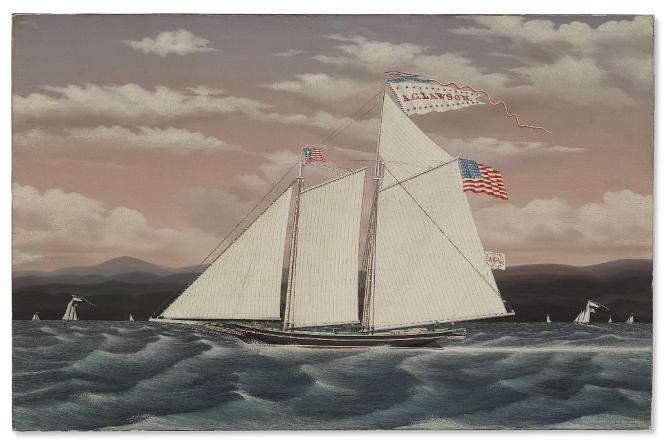
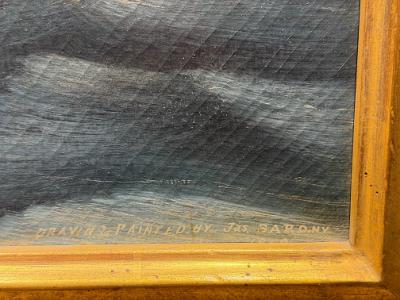
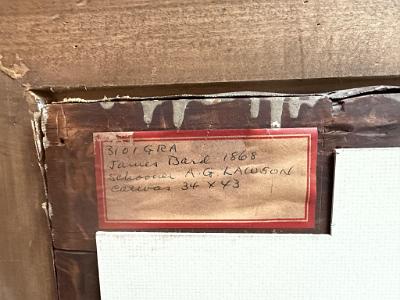
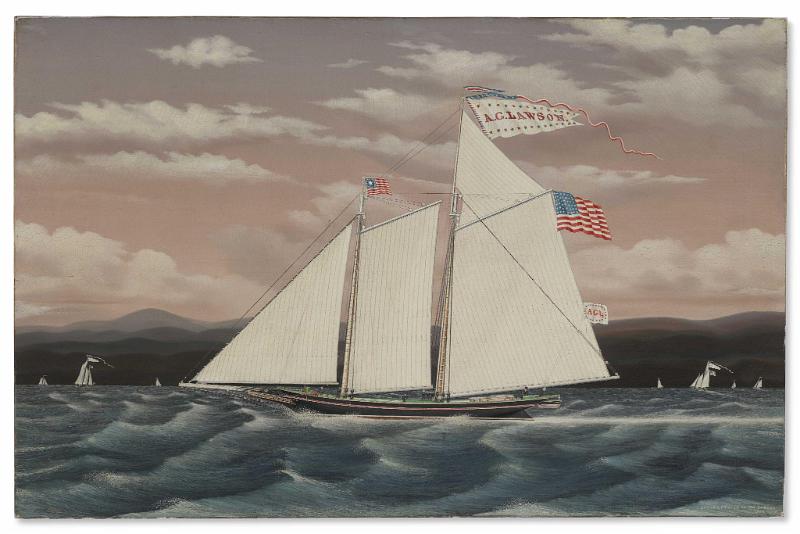
Oil on Canvas signed "DRAWN & PAINTED by Jas BARD NY 1868" of the Hudson River Schooner "A.G. Lawson"
Information JAMES BARD (1815-1897)
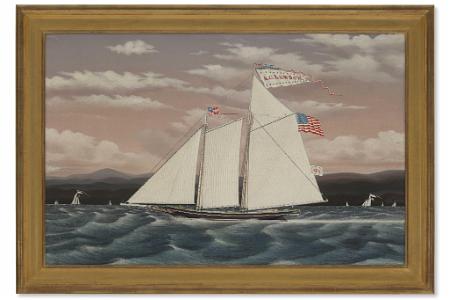
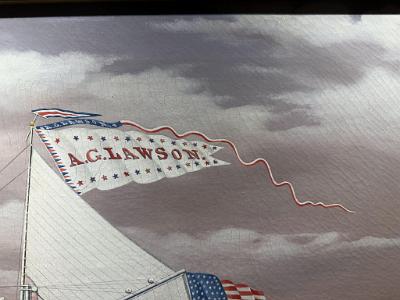
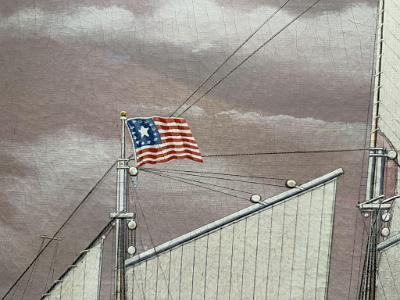
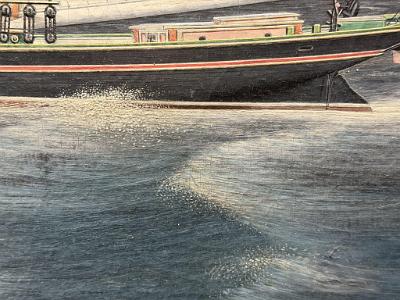
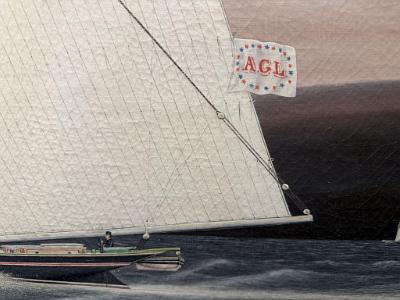
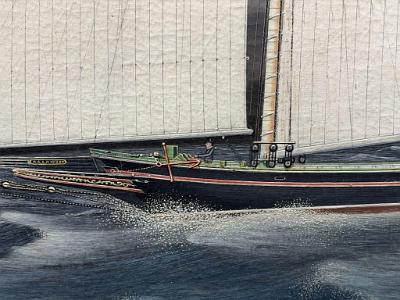
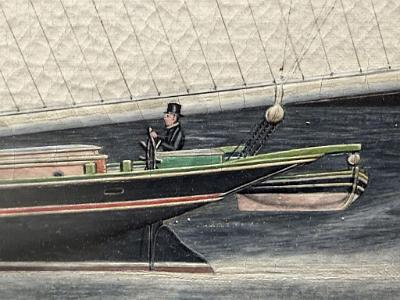
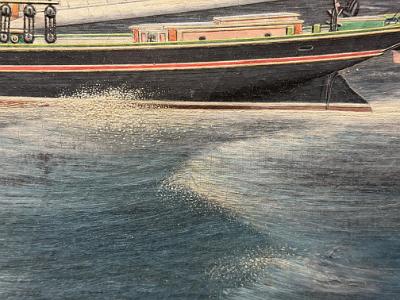
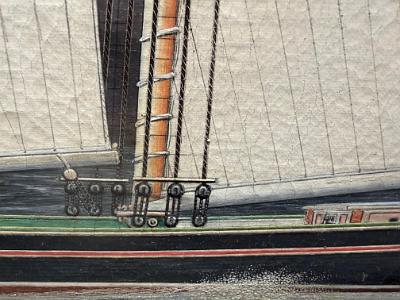
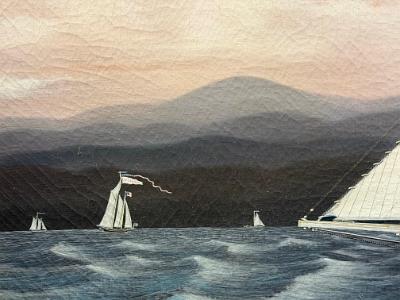
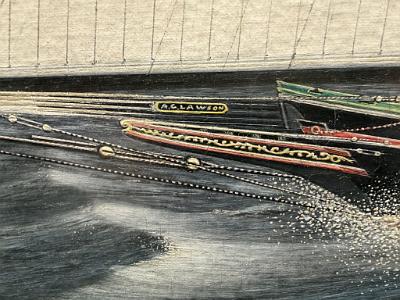
Oil on canvas, depicting the Hudson River schooner "A.G. Lawson", signed and dated 'DRAWN & PAINTED. BY. Jas. BARD. NY / 1868.' (lower right). The painting depicts the two masted schooner “A.G. LAWSON” under full sail with a top mast on the rear mast. The black hull design is typical for many of the Hudson River vessels with two-colored stripes just below the rail as well as a light-colored waterline stripe. The trail board is fancy and painted in gold. There is a small flag at the peak of the foremast with an American flag of a single star at the center encircled with thirteen stars. She is flying a large American flag off the gaff and above the rear boom there is a white flag with the initials “AGL”. She is flying a very large white banner from the peak of the rear mast with red Letters “A.G. LAWSON” and stars along the top and bottom borders. Above the name banner are two long and narrow red, white and blue streaming flags. Both to the left and right of the main vessel are small vessels also of the “A.G. Lawson” with name banners along with the American flag on each version. Bard painted his typical effervescent spray of the water as it hits the bow, and this effect repeats just past the main mast. Bard had various approaches to painting the water in his paintings. The method used in this painting show a similar effervescent effect on the crest of each wave which gives a magical effect to the water. The background shows the hills of the New Jersey shore, and the sky has wonderful white puffy clouds with a pink and purple sky.
Dimensions: Height 32 1⁄8, Width 52 3⁄8 in. (81.6 x 133 cm.)
Provenance: Old Print Shop; Maloy Collection
Reference 1: Anthony J. Peluso, Jr., “The Bard Brothers: Painting America Under Steam and Sail”, (New York, 1997), PP. 72, 165, illustrated full page.
Reference 2: "J & J Bard, Picture Painters" by A.J. Peluso Jr., Published by Hudson River Press, 152 Second Avenue. New York, N.Y. 1003. 1977, Page 51.
Note: This painting has a bold and imbued with patriotic exuberance, Albert G. (A.G.) Lawson is a rare and exemplary painting by James Bard. The oversized scale of the vessel in relation to the river, its meticulously drafted profile set against a simplified landscape, and the whimsically caricatured crew are details that distinguish Bard as the premier nineteenth-century American ship portraitist. Born in 1815, just eight years after Robert Fulton sent the Clermont up the Hudson on its maiden voyage, Bard witnessed the birth and growth of American industrialization and the dramatic evolution of the nation’s shipping industry.
By the time Bard painted the present work in 1868, sailing vessels had largely fallen out of favor on the Hudson River. Steamboats and railroads dominated its waters and shores; a shift reflected in Bard’s prolific oeuvre. Of the nearly 4,000 works attributed to him, only “some twenty oils of schooners and sloops” are known (Peluso, 1997, p. 73), making this painting a particularly rare and compelling composition.
As recorded in the Forty-Third Annual List of Merchant Vessels of the United States, A.G. Lawson was built in 1868 in Newburgh, New York. She measured 86 feet in length, weighed 94 gross tons, and carried a crew of three (Bureau of Navigation, Washington, D.C., 1911, p. 5, no. 1722). She was also exceptionally fast. A notice in the New York Herald on June 24, 1868, announced “a grand scrub race – open to all working schooners… The schooners Albert Lawson… now entered.” A.G. Lawson sailed and won the twenty-mile windward race on the Hudson River in both 1869 and 1870 (Peluso, p. 74). Bard underscores the schooner’s speed through the taut, narrow wake that trails behind it, as the vessel cuts through the waves with striking ease and grace.
1868
Classification(s)