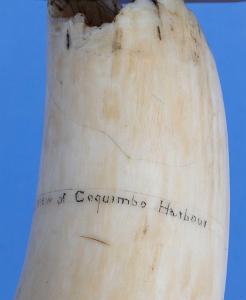
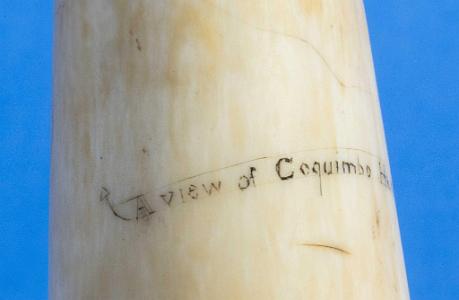
Scrimshaw Whales Tooth with the Engraved Title "A View of Coquimbo Harbor, Attributed Josiah of Nantucket, American Circa 1827
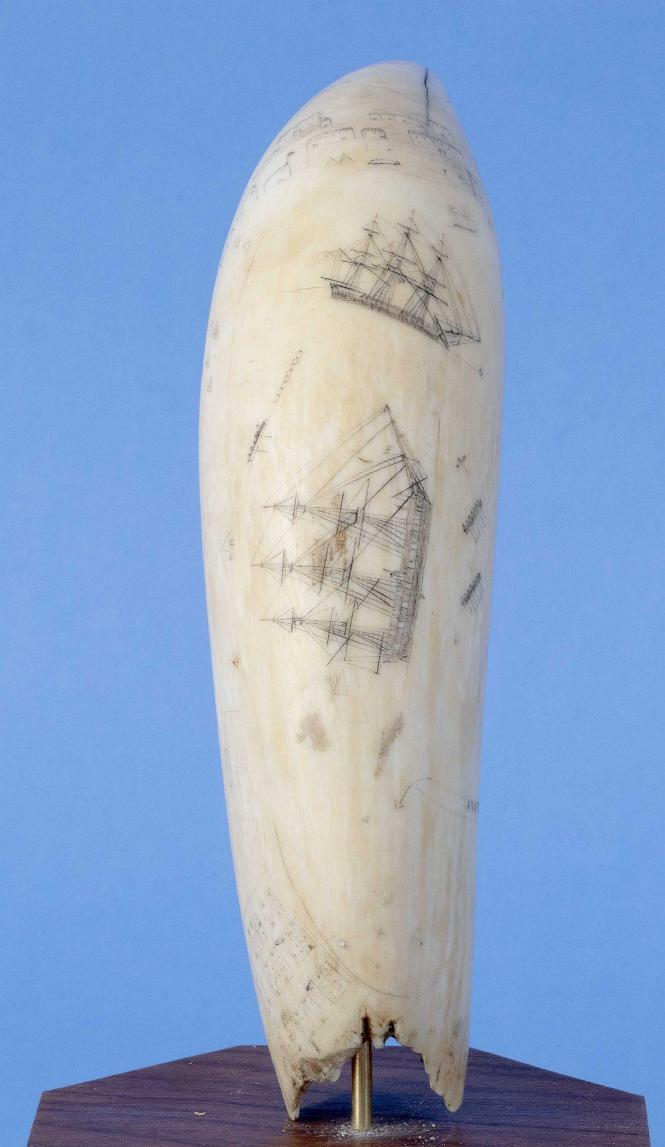
InformationSCRIMSHAW WHALE'S TOOTH "A VIEW OF COQUIMBO HARBOUR" Attributed to the well know early whalman Josiah Long circa 1827.
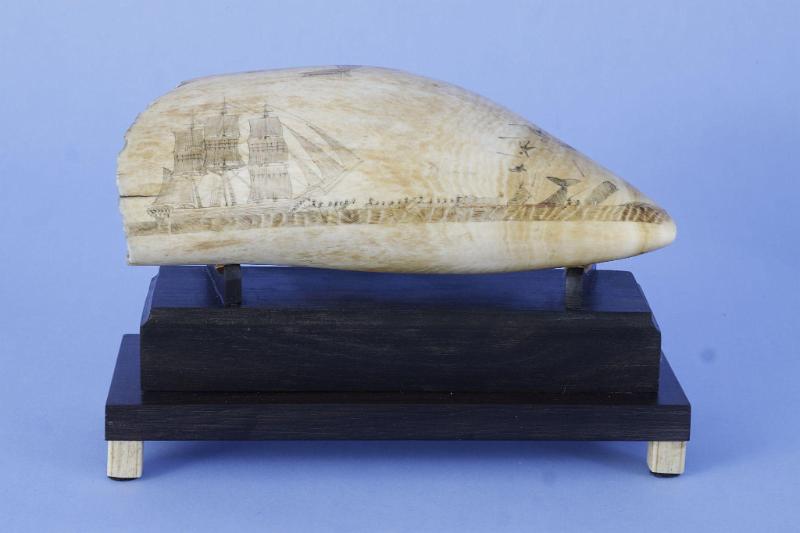
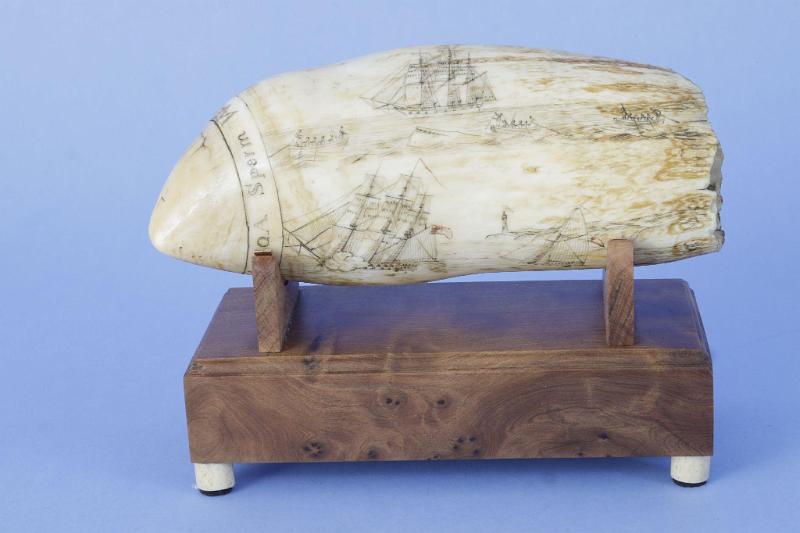
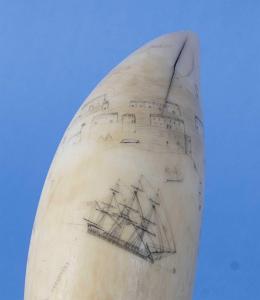
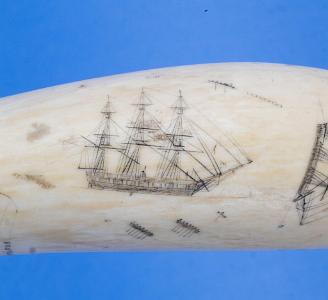
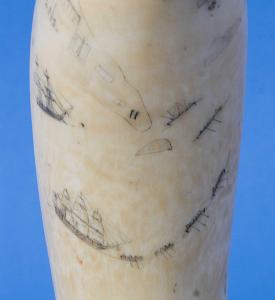
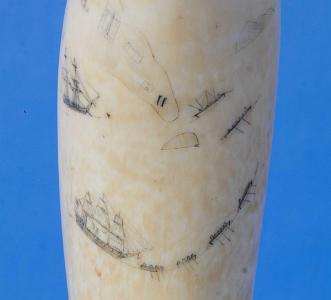
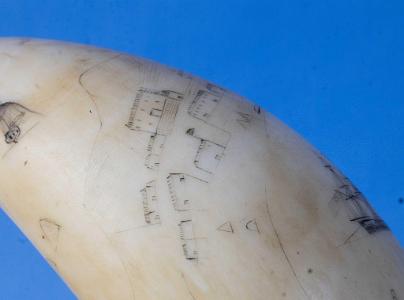
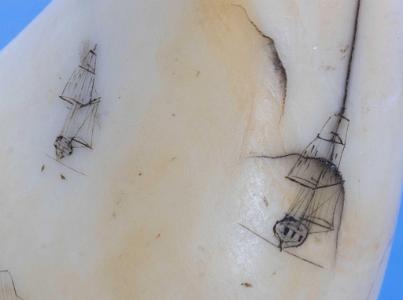
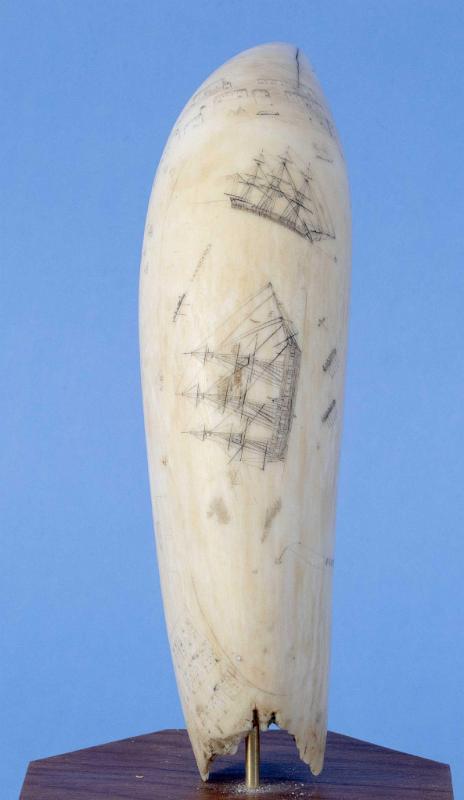
A finely detailed nearly bird's-eye view of the harbor, including several whaleships and manned whaleboats as well as buildings, fortifications, encampments, flags, mules and horses on the hilly shoreline, wraps around the circumference. Of note, one of the whaleships is being towed by four whaleboats. Titled in banner at mouth of harbor near base. (SC1339)
Length 6.5".
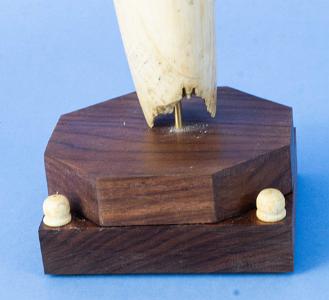
Condition: The tooth has a warm deep patina. There are a few typical age cracks at the tip and a few normal chips along the base. The tppth has a two tier walnut base.
Note: Coquimbo Harbour is a Pacific coastal city in Chile, known for its active fishing industry and copper production. Founded in 1826 and was a port used my American Whaleships in the early and mid-19th Century.
Provenance 1: "The Rare Folk Art & Marine Antiques collections of Jeffrey and Francine Cohen, July 31, 1989" Richard Bourne Auction Lot 133 caption "Extremely rare and important Scrimshaw Whale's Tooth by Frederick Myrick Entitled "A view of Coquimbo Harbour". The attribution to Myrick has bee proven incorrect however in an early voyage Josiah Long a Nantucket Whaleman appears as as keeper of a Journal spanning seven whaling voyages. The log is profusely illustrated journal that was kept by Josiah Long a known Nantucket Scimshander. In thje Edward Burdette appears as ship mates. The scene is laid out like an aerial map with four large ships, one of which is being towed to sea by four small boats, the other three ship's are at anchor with crews drilling in small boats nearby. The harbor encircles two-thirds of the tooth with buildings, people and animals visible on shore. Probably done by Myrick on the outward bound leg of his voyage on the "Susan" Ca 1828.
Provenance 2: "The Barbara Johnson Collection, Johnson Catalogue Part IV No. 448.
Josiah C. Long (Myrick's cousin and Shipmate)
Olive Coffin Long Saunders
Edward Saunders
“A View of Coquimbo Harbour” is an extremely important sperm whale tooth titled attributed to Nantucket born and career whaleman Josiah C. Long. In our research of Josiah C. Long we consider him as Nantucket whaling royalty having a whaling career spanning approximately 30 years and as Stuart Frank accurately states in his latest scrimshaw dictionary Long “served his entire apprenticeship and early career on one vessel, the ship Foster of Nantucket, and at age 27 he was rewarded with command of the Foster”. Long moved up the ladder quickly rising from the ranks of greenhand (1822-1824), boatsteerer (1825-1827), second mate (1828-1829), first mate (1829-1833) before serving as Captain of the Foster on two separate voyages from 1833-1841. Long went on to serve as master on two other vessels including the Richard Mitchell (1843-1847) and the Charles Carroll (1848-1852). The crew lists for all of Long’s voyages are included with this tooth.
In addition to a storied whaling career Long also has deep roots to other Nantucket whaling brass having served as shipmates aboard the Foster with Edward Burdette in 1822, Long was cousin to famed scrimshander Frederick Myrick (Susan’s teeth) and Long took over command of the Ship Charles Carroll after Captain Owen Chase, who was the captain of the doomed ship Essex which was stove by a whale in 1820. This is the most infamous whaling disaster in American whaling lore and served as the basis for Herman Melville’s literary masterpiece Moby Dick.
The tooth itself illustrates the Ship Foster at anchor during its 1827 stop in Coquimbo Harbour, a well visited port off the coast of Chile for American and Foreign whaling vessels for provisional refills (fruit, vegetable, water etc) during whaling voyages to the pacific. The following excerpt taken directly from the journal kept by Josiah C Long details the 5 weeks stay as follows:
“…On the 30th put of for Coquimbo for Wright(sic) Whales, on the 31st came at anchor found the following Ships at anchor George Captain Charles Lovenance 1700 bls, Globe Captain Reuban Swain 1550 bls, Peru Captain Samuel Joy 1400 bls all of Nantucket about the middle of June got a Wright(sic) whale to be divided between the three ships the Globe having gone out about the same time the Franklin of Nantucket came in Capt. Thadeus Coffin 2000 bls got one more whale to be divided between the 4 ships our part of both whales amounted to 40 bls that ended the wright(sic) whale search after being there 5 weeks got water and of the 7th of July got underway bound to the United States. “
Tooth Illustrations:
Picture 1 - American Ship at Anchor – There is one ship with an American flag we can assume to be the Foster. Compare Long’s Ship Portrait of Charles Carrol flying American flag.
Picture 2 – Two ships leaving Coquimbo Harbour near outcropping of rocks. Compare stern view of ships under pyramid sail to the stern view ships under full pyramid sail to Charles Carrol journal.
Picture 3 – Pictures of whaleboats in search of Right whales. The few boats seem to have 7 people but I can only see 6 oars. We can look under magnification. No whales are pictures but according to the journal entry only two whales in total were taken during the 5 week stay and the language sort of hints that is why they left Coquimbo – bad fishing.
Picture 4 – whaleboat towing empty crates toward land like to pick up provisions – meat, fruit, vegetables water etc.
Picture 5 – Whaleship being towed out to open ocean due to poor wind or other reason.
Picture 6 – Pictures of Coquimbo landmarks, animals, fort etc.
Provenance
LOT 448 - The Barbara Johnson Whaling Collection: Part IV December 16 and 17, 1983. The tooth was sold only a few lots after the only other tooth known to be engraved by Josiah C. Long which was Lot #445.
LOT 445 – The Barbara Johnson Whaling Collection: Part IV December 16 and 17, 1983 was a sperm tooth attributed to Josiah C. Long. On page 451 of his latest Scrimshaw dictionary Stuart Frank acknowledges this tooth as an authentic work of Josiah C. Long.
LOT 444 - The Barbara Johnson Whaling Collection: Part IV December 16 and 17, 1983 was a profusely illustrated journal kept by Master Josiah C. Long while he was Captain of the ship Charles Carroll during the years1848-1852. This important log was purchased at Elred’s Fall Marine sale in 2018 – LOT #1 sold for $90,000 including auction premium and now resides in the collection of the NHA.
The provenance for all 3 Barbara Johnson Lots sold in 1983 had the same provenance:
Josiah C Long
Olive Coffin Long Saunders
Edward Saunders
“A View of Coquimbo Harbour” is an extremely important sperm whale tooth titled attributed to Nantucket born and career whaleman Josiah C. Long. In our research of Josiah C. Long we consider him as Nantucket whaling royalty having a whaling career spanning approximately 30 years and as Stuart Frank accurately states in his latest scrimshaw dictionary Long “served his entire apprenticeship and early career on one vessel, the ship Foster of Nantucket, and at age 27 he was rewarded with command of the Foster”. Long moved up the ladder quickly rising from the ranks of greenhand (1822-1824), boatsteerer (1825-1827), second mate (1828-1829), first mate (1829-1833) before serving as Captain of the Foster on two separate voyages from 1833-1841. Long went on to serve as master on two other vessels including the Richard Mitchell (1843-1847) and the Charles Carroll (1848-1852). The crew lists for all of Long’s voyages are included with this tooth.
In addition to a storied whaling career Long also has deep roots to other Nantucket whaling brass having served as shipmates aboard the Foster with Edward Burdette in 1822, Long was cousin to famed scrimshander Frederick Myrick (Susan’s teeth) and Long took over command of the Ship Charles Carroll after Captain Owen Chase, who was the captain of the doomed ship Essex which was stove by a whale in 1820. This is the most infamous whaling disaster in American whaling lore and served as the basis for Herman Melville’s literary masterpiece Moby Dick.
The tooth itself illustrates the Ship Foster at anchor during its 1827 stop in Coquimbo Harbour, a well visited port off the coast of Chile for American and Foreign whaling vessels for provisional refills (fruit, vegetable, water etc) during whaling voyages to the pacific. The following excerpt taken directly from the journal kept by Josiah C Long details the 5 weeks stay as follows:
“…On the 30th put of for Coquimbo for Wright(sic) Whales, on the 31st came at anchor found the following Ships at anchor George Captain Charles Lovenance 1700 bls, Globe Captain Reuban Swain 1550 bls, Peru Captain Samuel Joy 1400 bls all of Nantucket about the middle of June got a Wright(sic) whale to be divided between the three ships the Globe having gone out about the same time the Franklin of Nantucket came in Capt. Thadeus Coffin 2000 bls got one more whale to be divided between the 4 ships our part of both whales amounted to 40 bls that ended the wright(sic) whale search after being there 5 weeks got water and of the 7th of July got underway bound to the United States. “
Tooth Illustrations:
Picture 1 - American Ship at Anchor – There is one ship with an American flag we can assume to be the Foster. Compare Long’s Ship Portrait of Charles Carrol flying American flag.
Picture 2 – Two ships leaving Coquimbo Harbour near outcropping of rocks. Compare stern view of ships under pyramid sail to the stern view ships under full pyramid sail to Charles Carrol journal.
Picture 3 – Pictures of whaleboats in search of Right whales. The few boats seem to have 7 people but I can only see 6 oars. We can look under magnification. No whales are pictures but according to the journal entry only two whales in total were taken during the 5 week stay and the language sort of hints that is why they left Coquimbo – bad fishing.
Picture 4 – whaleboat towing empty crates toward land like to pick up provisions – meat, fruit, vegetables water etc.
Picture 5 – Whaleship being towed out to open ocean due to poor wind or other reason.
Picture 6 – Pictures of Coquimbo landmarks, animals, fort etc.
Provenance
LOT 448 - The Barbara Johnson Whaling Collection: Part IV December 16 and 17, 1983. The tooth was sold only a few lots after the only other tooth known to be engraved by Josiah C. Long which was Lot #445.
LOT 445 – The Barbara Johnson Whaling Collection: Part IV December 16 and 17, 1983 was a sperm tooth attributed to Josiah C. Long. On page 451 of his latest Scrimshaw dictionary Stuart Frank acknowledges this tooth as an authentic work of Josiah C. Long.
LOT 444 - The Barbara Johnson Whaling Collection: Part IV December 16 and 17, 1983 was a profusely illustrated journal kept by Master Josiah C. Long while he was Captain of the ship Charles Carroll during the years1848-1852. This important log was purchased at Elred’s Fall Marine sale in 2018 – LOT #1 sold for $90,000 including auction premium and now resides in the collection of the NHA.
The provenance for all 3 Barbara Johnson Lots sold in 1983 had the same provenance:
Josiah C Long
Olive Coffin Long Saunders
Edward Saunders
“A View of Coquimbo Harbour” is an extremely important sperm whale tooth titled attributed to Nantucket born and career whaleman Josiah C. Long. In our research of Josiah C. Long we consider him as Nantucket whaling royalty having a whaling career spanning approximately 30 years and as Stuart Frank accurately states in his latest scrimshaw dictionary Long “served his entire apprenticeship and early career on one vessel, the ship Foster of Nantucket, and at age 27 he was rewarded with command of the Foster”. Long moved up the ladder quickly rising from the ranks of greenhand (1822-1824), boatsteerer (1825-1827), second mate (1828-1829), first mate (1829-1833) before serving as Captain of the Foster on two separate voyages from 1833-1841. Long went on to serve as master on two other vessels including the Richard Mitchell (1843-1847) and the Charles Carroll (1848-1852). The crew lists for all of Long’s voyages are included with this tooth.
In addition to a storied whaling career Long also has deep roots to other Nantucket whaling brass having served as shipmates aboard the Foster with Edward Burdette in 1822, Long was cousin to famed scrimshander Frederick Myrick (Susan’s teeth) and Long took over command of the Ship Charles Carroll after Captain Owen Chase, who was the captain of the doomed ship Essex which was stove by a whale in 1820. This is the most infamous whaling disaster in American whaling lore and served as the basis for Herman Melville’s literary masterpiece Moby Dick.
The tooth itself illustrates the Ship Foster at anchor during its 1827 stop in Coquimbo Harbour, a well visited port off the coast of Chile for American and Foreign whaling vessels for provisional refills (fruit, vegetable, water etc) during whaling voyages to the pacific. The following excerpt taken directly from the journal kept by Josiah C Long details the 5 weeks stay as follows:
“…On the 30th put of for Coquimbo for Wright(sic) Whales, on the 31st came at anchor found the following Ships at anchor George Captain Charles Lovenance 1700 bls, Globe Captain Reuban Swain 1550 bls, Peru Captain Samuel Joy 1400 bls all of Nantucket about the middle of June got a Wright(sic) whale to be divided between the three ships the Globe having gone out about the same time the Franklin of Nantucket came in Capt. Thadeus Coffin 2000 bls got one more whale to be divided between the 4 ships our part of both whales amounted to 40 bls that ended the wright(sic) whale search after being there 5 weeks got water and of the 7th of July got underway bound to the United States. “
Tooth Illustrations:
Picture 1 - American Ship at Anchor – There is one ship with an American flag we can assume to be the Foster. Compare Long’s Ship Portrait of Charles Carrol flying American flag.
Picture 2 – Two ships leaving Coquimbo Harbour near outcropping of rocks. Compare stern view of ships under pyramid sail to the stern view ships under full pyramid sail to Charles Carrol journal.
Picture 3 – Pictures of whaleboats in search of Right whales. The few boats seem to have 7 people but I can only see 6 oars. We can look under magnification. No whales are pictures but according to the journal entry only two whales in total were taken during the 5 week stay and the language sort of hints that is why they left Coquimbo – bad fishing.
Picture 4 – whaleboat towing empty crates toward land like to pick up provisions – meat, fruit, vegetables water etc.
Picture 5 – Whaleship being towed out to open ocean due to poor wind or other reason.
Picture 6 – Pictures of Coquimbo landmarks, animals, fort etc.
Provenance
LOT 448 - The Barbara Johnson Whaling Collection: Part IV December 16 and 17, 1983. The tooth was sold only a few lots after the only other tooth known to be engraved by Josiah C. Long which was Lot #445.
LOT 445 – The Barbara Johnson Whaling Collection: Part IV December 16 and 17, 1983 was a sperm tooth attributed to Josiah C. Long. On page 451 of his latest Scrimshaw dictionary Stuart Frank acknowledges this tooth as an authentic work of Josiah C. Long.
LOT 444 - The Barbara Johnson Whaling Collection: Part IV December 16 and 17, 1983 was a profusely illustrated journal kept by Master Josiah C. Long while he was Captain of the ship Charles Carroll during the years1848-1852. This important log was purchased at Elred’s Fall Marine sale in 2018 – LOT #1 sold for $90,000 including auction premium and now resides in the collection of the NHA.
The provenance for all 3 Barbara Johnson Lots sold in 1983 had the same provenance:
Josiah C Long
Olive Coffin Long Saunders
Edward Saunders
“A View of Coquimbo Harbour” is an extremely important sperm whale tooth titled attributed to Nantucket born and career whaleman Josiah C. Long. In our research of Josiah C. Long we consider him as Nantucket whaling royalty having a whaling career spanning approximately 30 years and as Stuart Frank accurately states in his latest scrimshaw dictionary Long “served his entire apprenticeship and early career on one vessel, the ship Foster of Nantucket, and at age 27 he was rewarded with command of the Foster”. Long moved up the ladder quickly rising from the ranks of greenhand (1822-1824), boatsteerer (1825-1827), second mate (1828-1829), first mate (1829-1833) before serving as Captain of the Foster on two separate voyages from 1833-1841. Long went on to serve as master on two other vessels including the Richard Mitchell (1843-1847) and the Charles Carroll (1848-1852). The crew lists for all of Long’s voyages are included with this tooth.
In addition to a storied whaling career Long also has deep roots to other Nantucket whaling brass having served as shipmates aboard the Foster with Edward Burdette in 1822, Long was cousin to famed scrimshander Frederick Myrick (Susan’s teeth) and Long took over command of the Ship Charles Carroll after Captain Owen Chase, who was the captain of the doomed ship Essex which was stove by a whale in 1820. This is the most infamous whaling disaster in American whaling lore and served as the basis for Herman Melville’s literary masterpiece Moby Dick.
The tooth itself illustrates the Ship Foster at anchor during its 1827 stop in Coquimbo Harbour, a well visited port off the coast of Chile for American and Foreign whaling vessels for provisional refills (fruit, vegetable, water etc) during whaling voyages to the pacific. The following excerpt taken directly from the journal kept by Josiah C Long details the 5 weeks stay as follows:
“…On the 30th put of for Coquimbo for Wright(sic) Whales, on the 31st came at anchor found the following Ships at anchor George Captain Charles Lovenance 1700 bls, Globe Captain Reuban Swain 1550 bls, Peru Captain Samuel Joy 1400 bls all of Nantucket about the middle of June got a Wright(sic) whale to be divided between the three ships the Globe having gone out about the same time the Franklin of Nantucket came in Capt. Thadeus Coffin 2000 bls got one more whale to be divided between the 4 ships our part of both whales amounted to 40 bls that ended the wright(sic) whale search after being there 5 weeks got water and of the 7th of July got underway bound to the United States. “
Tooth Illustrations:
Picture 1 - American Ship at Anchor – There is one ship with an American flag we can assume to be the Foster. Compare Long’s Ship Portrait of Charles Carrol flying American flag.
Picture 2 – Two ships leaving Coquimbo Harbour near outcropping of rocks. Compare stern view of ships under pyramid sail to the stern view ships under full pyramid sail to Charles Carrol journal.
Picture 3 – Pictures of whaleboats in search of Right whales. The few boats seem to have 7 people but I can only see 6 oars. We can look under magnification. No whales are pictures but according to the journal entry only two whales in total were taken during the 5 week stay and the language sort of hints that is why they left Coquimbo – bad fishing.
Picture 4 – whaleboat towing empty crates toward land like to pick up provisions – meat, fruit, vegetables water etc.
Picture 5 – Whaleship being towed out to open ocean due to poor wind or other reason.
Picture 6 – Pictures of Coquimbo landmarks, animals, fort etc.
Provenance
LOT 448 - The Barbara Johnson Whaling Collection: Part IV December 16 and 17, 1983. The tooth was sold only a few lots after the only other tooth known to be engraved by Josiah C. Long which was Lot #445.
LOT 445 – The Barbara Johnson Whaling Collection: Part IV December 16 and 17, 1983 was a sperm tooth attributed to Josiah C. Long. On page 451 of his latest Scrimshaw dictionary Stuart Frank acknowledges this tooth as an authentic work of Josiah C. Long.
LOT 444 - The Barbara Johnson Whaling Collection: Part IV December 16 and 17, 1983 was a profusely illustrated journal kept by Master Josiah C. Long while he was Captain of the ship Charles Carroll during the years1848-1852. This important log was purchased at Elred’s Fall Marine sale in 2018 – LOT #1 sold for $90,000 including auction premium and now resides in the collection of the NHA.
The provenance for all 3 Barbara Johnson Lots sold in 1983 had the same provenance:
Josiah C Long
Olive Coffin Long Saunders
Edward Saunders
“A View of Coquimbo Harbour” is an extremely important sperm whale tooth titled attributed to Nantucket born and career whaleman Josiah C. Long. In our research of Josiah C. Long we consider him as Nantucket whaling royalty having a whaling career spanning approximately 30 years and as Stuart Frank accurately states in his latest scrimshaw dictionary Long “served his entire apprenticeship and early career on one vessel, the ship Foster of Nantucket, and at age 27 he was rewarded with command of the Foster”. Long moved up the ladder quickly rising from the ranks of greenhand (1822-1824), boatsteerer (1825-1827), second mate (1828-1829), first mate (1829-1833) before serving as Captain of the Foster on two separate voyages from 1833-1841. Long went on to serve as master on two other vessels including the Richard Mitchell (1843-1847) and the Charles Carroll (1848-1852). The crew lists for all of Long’s voyages are included with this tooth.
In addition to a storied whaling career Long also has deep roots to other Nantucket whaling brass having served as shipmates aboard the Foster with Edward Burdette in 1822, Long was cousin to famed scrimshander Frederick Myrick (Susan’s teeth) and Long took over command of the Ship Charles Carroll after Captain Owen Chase, who was the captain of the doomed ship Essex which was stove by a whale in 1820. This is the most infamous whaling disaster in American whaling lore and served as the basis for Herman Melville’s literary masterpiece Moby Dick.
The tooth itself illustrates the Ship Foster at anchor during its 1827 stop in Coquimbo Harbour, a well visited port off the coast of Chile for American and Foreign whaling vessels for provisional refills (fruit, vegetable, water etc) during whaling voyages to the pacific. The following excerpt taken directly from the journal kept by Josiah C Long details the 5 weeks stay as follows:
“…On the 30th put of for Coquimbo for Wright(sic) Whales, on the 31st came at anchor found the following Ships at anchor George Captain Charles Lovenance 1700 bls, Globe Captain Reuban Swain 1550 bls, Peru Captain Samuel Joy 1400 bls all of Nantucket about the middle of June got a Wright(sic) whale to be divided between the three ships the Globe having gone out about the same time the Franklin of Nantucket came in Capt. Thadeus Coffin 2000 bls got one more whale to be divided between the 4 ships our part of both whales amounted to 40 bls that ended the wright(sic) whale search after being there 5 weeks got water and of the 7th of July got underway bound to the United States. “
Tooth Illustrations:
Picture 1 - American Ship at Anchor – There is one ship with an American flag we can assume to be the Foster. Compare Long’s Ship Portrait of Charles Carrol flying American flag.
Picture 2 – Two ships leaving Coquimbo Harbour near outcropping of rocks. Compare stern view of ships under pyramid sail to the stern view ships under full pyramid sail to Charles Carrol journal.
Picture 3 – Pictures of whaleboats in search of Right whales. The few boats seem to have 7 people but I can only see 6 oars. We can look under magnification. No whales are pictures but according to the journal entry only two whales in total were taken during the 5 week stay and the language sort of hints that is why they left Coquimbo – bad fishing.
Picture 4 – whaleboat towing empty crates toward land like to pick up provisions – meat, fruit, vegetables water etc.
Picture 5 – Whaleship being towed out to open ocean due to poor wind or other reason.
Picture 6 – Pictures of Coquimbo landmarks, animals, fort etc.
Provenance
LOT 448 - The Barbara Johnson Whaling Collection: Part IV December 16 and 17, 1983. The tooth was sold only a few lots after the only other tooth known to be engraved by Josiah C. Long which was Lot #445.
LOT 445 – The Barbara Johnson Whaling Collection: Part IV December 16 and 17, 1983 was a sperm tooth attributed to Josiah C. Long. On page 451 of his latest Scrimshaw dictionary Stuart Frank acknowledges this tooth as an authentic work of Josiah C. Long.
LOT 444 - The Barbara Johnson Whaling Collection: Part IV December 16 and 17, 1983 was a profusely illustrated journal kept by Master Josiah C. Long while he was Captain of the ship Charles Carroll during the years1848-1852. This important log was purchased at Elred’s Fall Marine sale in 2018 – LOT #1 sold for $90,000 including auction premium and now resides in the collection of the NHA.
The provenance for all 3 Barbara Johnson Lots sold in 1983 had the same provenance:
Josiah C Long
Olive Coffin Long Saunders
Edward Saunders
“A View of Coquimbo Harbour” is an extremely important sperm whale tooth titled attributed to Nantucket born and career whaleman Josiah C. Long. In our research of Josiah C. Long we consider him as Nantucket whaling royalty having a whaling career spanning approximately 30 years and as Stuart Frank accurately states in his latest scrimshaw dictionary Long “served his entire apprenticeship and early career on one vessel, the ship Foster of Nantucket, and at age 27 he was rewarded with command of the Foster”. Long moved up the ladder quickly rising from the ranks of greenhand (1822-1824), boatsteerer (1825-1827), second mate (1828-1829), first mate (1829-1833) before serving as Captain of the Foster on two separate voyages from 1833-1841. Long went on to serve as master on two other vessels including the Richard Mitchell (1843-1847) and the Charles Carroll (1848-1852). The crew lists for all of Long’s voyages are included with this tooth.
In addition to a storied whaling career Long also has deep roots to other Nantucket whaling brass having served as shipmates aboard the Foster with Edward Burdette in 1822, Long was cousin to famed scrimshander Frederick Myrick (Susan’s teeth) and Long took over command of the Ship Charles Carroll after Captain Owen Chase, who was the captain of the doomed ship Essex which was stove by a whale in 1820. This is the most infamous whaling disaster in American whaling lore and served as the basis for Herman Melville’s literary masterpiece Moby Dick.
The tooth itself illustrates the Ship Foster at anchor during its 1827 stop in Coquimbo Harbour, a well visited port off the coast of Chile for American and Foreign whaling vessels for provisional refills (fruit, vegetable, water etc) during whaling voyages to the pacific. The following excerpt taken directly from the journal kept by Josiah C Long details the 5 weeks stay as follows:
“…On the 30th put of for Coquimbo for Wright(sic) Whales, on the 31st came at anchor found the following Ships at anchor George Captain Charles Lovenance 1700 bls, Globe Captain Reuban Swain 1550 bls, Peru Captain Samuel Joy 1400 bls all of Nantucket about the middle of June got a Wright(sic) whale to be divided between the three ships the Globe having gone out about the same time the Franklin of Nantucket came in Capt. Thadeus Coffin 2000 bls got one more whale to be divided between the 4 ships our part of both whales amounted to 40 bls that ended the wright(sic) whale search after being there 5 weeks got water and of the 7th of July got underway bound to the United States. “
Tooth Illustrations:
Picture 1 - American Ship at Anchor – There is one ship with an American flag we can assume to be the Foster. Compare Long’s Ship Portrait of Charles Carrol flying American flag.
Picture 2 – Two ships leaving Coquimbo Harbour near outcropping of rocks. Compare stern view of ships under pyramid sail to the stern view ships under full pyramid sail to Charles Carrol journal.
Picture 3 – Pictures of whaleboats in search of Right whales. The few boats seem to have 7 people but I can only see 6 oars. We can look under magnification. No whales are pictures but according to the journal entry only two whales in total were taken during the 5 week stay and the language sort of hints that is why they left Coquimbo – bad fishing.
Picture 4 – whaleboat towing empty crates toward land like to pick up provisions – meat, fruit, vegetables water etc.
Picture 5 – Whaleship being towed out to open ocean due to poor wind or other reason.
Picture 6 – Pictures of Coquimbo landmarks, animals, fort etc.
Provenance
LOT 448 - The Barbara Johnson Whaling Collection: Part IV December 16 and 17, 1983. The tooth was sold only a few lots after the only other tooth known to be engraved by Josiah C. Long which was Lot #445.
LOT 445 – The Barbara Johnson Whaling Collection: Part IV December 16 and 17, 1983 was a sperm tooth attributed to Josiah C. Long. On page 451 of his latest Scrimshaw dictionary Stuart Frank acknowledges this tooth as an authentic work of Josiah C. Long.
LOT 444 - The Barbara Johnson Whaling Collection: Part IV December 16 and 17, 1983 was a profusely illustrated journal kept by Master Josiah C. Long while he was Captain of the ship Charles Carroll during the years1848-1852. This important log was purchased at Elred’s Fall Marine sale in 2018 – LOT #1 sold for $90,000 including auction premium and now resides in the collection of the NHA.
The provenance for all 3 Barbara Johnson Lots sold in 1983 had the same provenance:
Josiah C Long
Olive Coffin Long Saunders
Edward Saunders
Circa 1828