Outstanding and Rare Scrimshaw, Signed and Dated Bird Cage , dated 1862
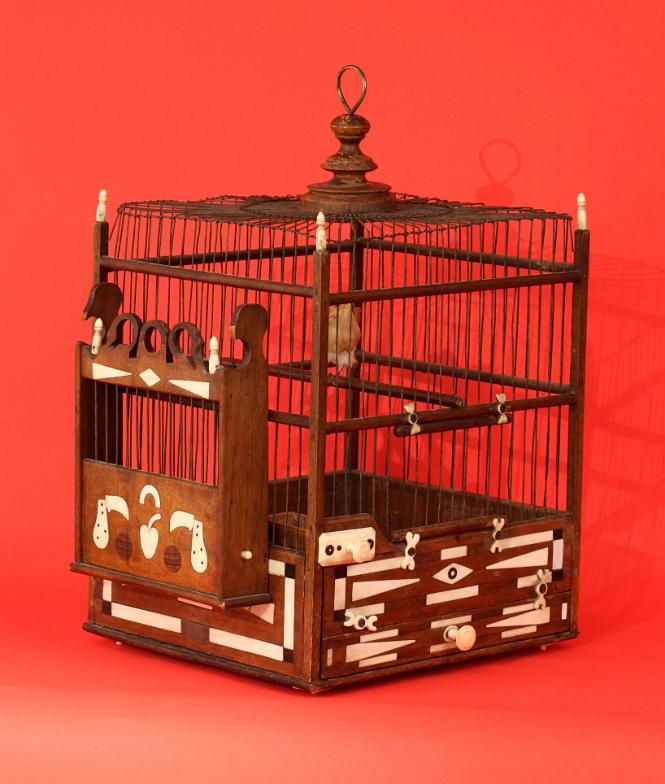
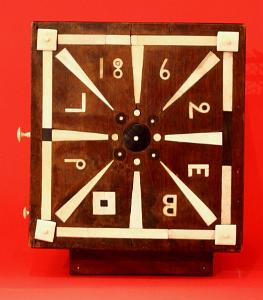
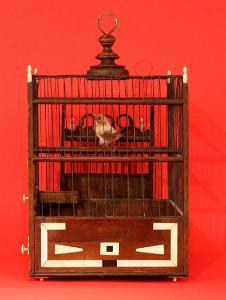
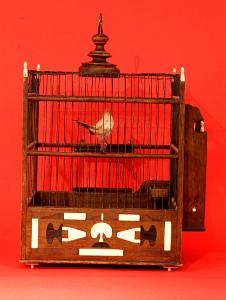
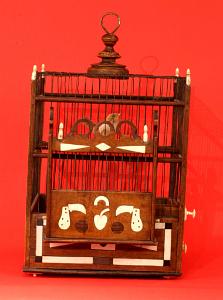
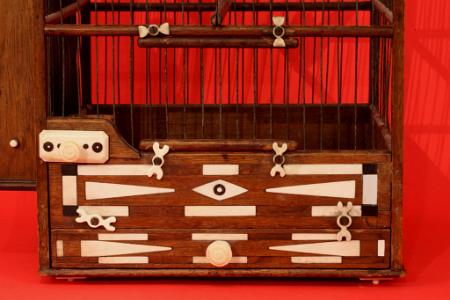
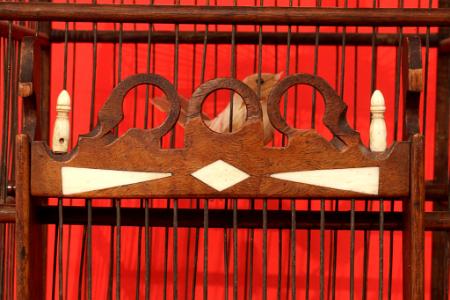
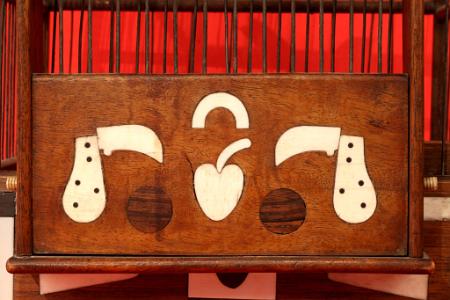
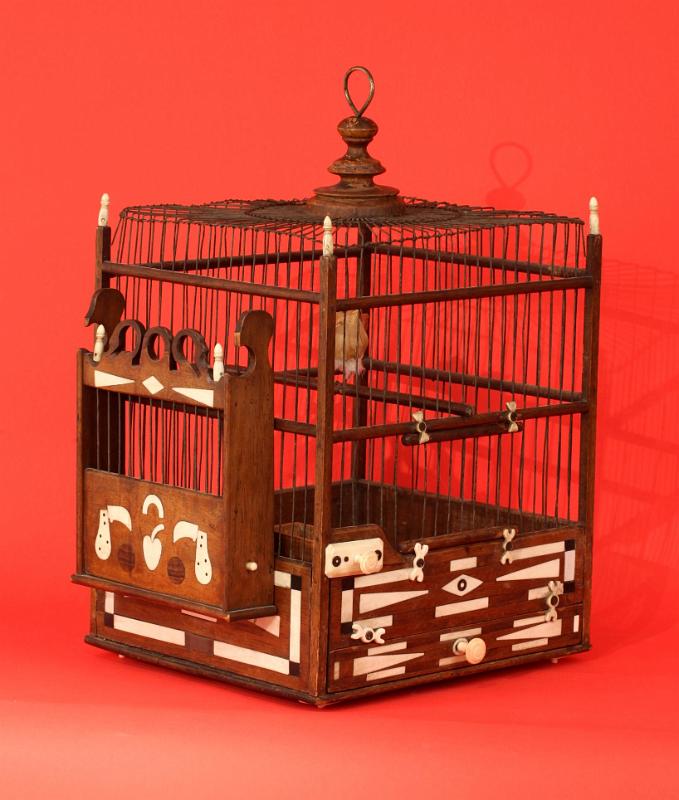
InformationExtremely rare and important scrimshaw bird cage, dated 1862 The wire enclosed square cage with pegged construction is inlaid with whale ivory, whalebone, baleen and exotic woods. Mounted to the side of the cage on the wire is a removable compartment with carved swan heads, inlaid in cherry, skinning and chopping knife designs. To the left is a small pullout feeding draw with an ivory pull and below is an inlaid ivory and bone clean-out drawer which has whalebone turn-knuckle locks. The top of the cage has whalebone finials and the bottom has bone feet. The base is inlaid with a compass rose and the intials "EB" and "PL" and is dated 1862. At the center of the top of the cage is a bulbous turned finial with a metal hanging or carrying ring. Running across the cage near the middle is a wood dowel with a realistic looking small bird with talons and feathers perched near the center.
Note:The inlaid inscription on the bottom “E/B/[flag]/d/L/18/62” appears to be some kind of private cypher. I take “EB” to be the initials of the maker or intended recipient (but which?), and “1862” to be the date, either the year the birdcage was made or the date of some other event, such as a birth or marriage. The flag may be the “Blue Peter” — the letter P: a white square centered in a blue field — which in international nautical signal usage signifies “All persons to report aboard as the vessel is about to sail” (this was a very common feature in the Royal Navy and in the merchant services internationally). Or it may be the letter S: a blue square centered in a white field. So in may simply represent the letter (or initial) P or the letter (or initial) S. Signal-flag systems have varied over the past two or three centuries: in some, a square in a different-colored field can represent the number 4 or the number 2. In the absence of a significant provenance, hopes of decoding the cypher are very slim. The birdcage is a fine piece of work, but in the absence of a provenance, anonymous, probably made circa 1862. MI5016
Dimensions: Height 19 1/2, Width 11, Depth 10 1/2 inches
Double Page Spread (MI5016_1,2,3)
Left Page: large as possible
Right Page: (MI5016_2) and beside it (MI5016_3) Make same height as opposite page
Description on right page
Scrimshaw Inlaid Bird Cage
Scrimshaw bird cage, dated 1862 The wire enclosed square cage with pegged construction is inlaid with whale ivory, whalebone, baleen and exotic woods. Mounted to the side of the cage on the wire is a removable compartment with carved swan heads, inlaid in cherry, skinning and chopping knife designs. To the left is a small pullout feeding draw with an ivory pull and below is an inlaid ivory and bone clean-out drawer which has whalebone turn-knuckle locks. The top of the cage has whalebone finials and the bottom has bone feet. The base is inlaid with a compass rose and the intials "EB" and "PL" and is dated 1862. At the center of the top of the cage is a bulbous turned finial with a metal hanging or carrying ring. Running across the cage near the middle is a wood dowel with a realistic looking small bird with talons and feathers perched near the center.
Note:The inlaid inscription on the bottom “E/B/[flag]/d/L/18/62” appears to be some kind of private cypher. I take “EB” to be the initials of the maker or intended recipient (but which?), and “1862” to be the date, either the year the birdcage was made or the date of some other event, such as a birth or marriage. The flag may be the “Blue Peter” — the letter P: a white square centered in a blue field — which in international nautical signal usage signifies “All persons to report aboard as the vessel is about to sail” (this was a very common feature in the Royal Navy and in the merchant services internationally). Or it may be the letter S: a blue square centered in a white field. So it may simply represent the letter (or initial) P or the letter (or initial) S. Signal-flag systems have varied over the past two or three centuries: in some, a square in a different-colored field can represent the number 4 or the number 2.
Private Collection
Dated 1862
H: 19 1/;, W: 11; D: 10 1/2 inches
Plate 14.50a
Plate 14.50b
Plate 143.50c
Dated 1862