Full Plate Ambrotype of Niagra Falls with a Period Thermoplastic Case Featuring "Washington Crossing the Delaware"'.
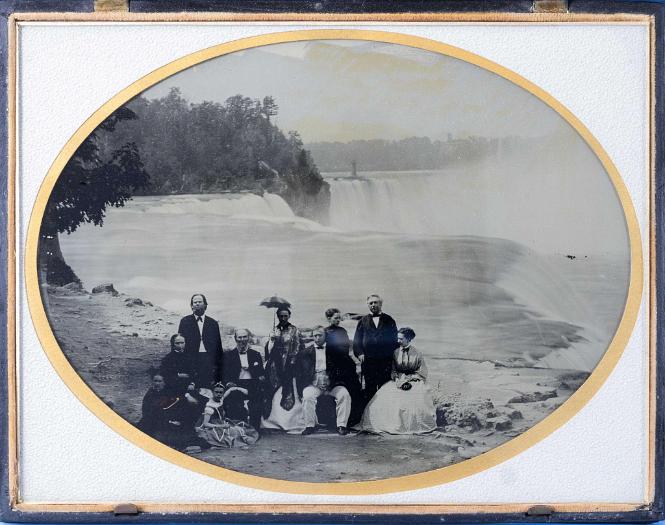
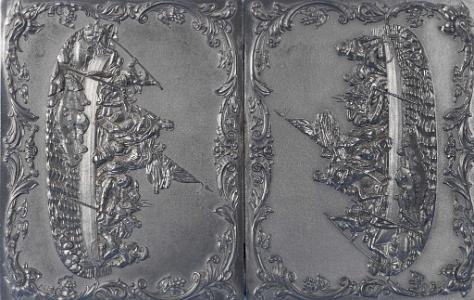
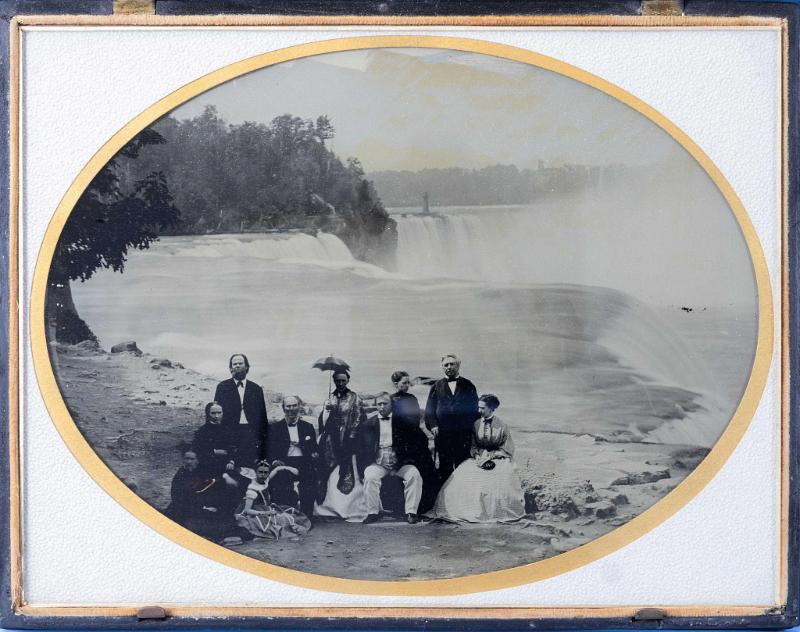
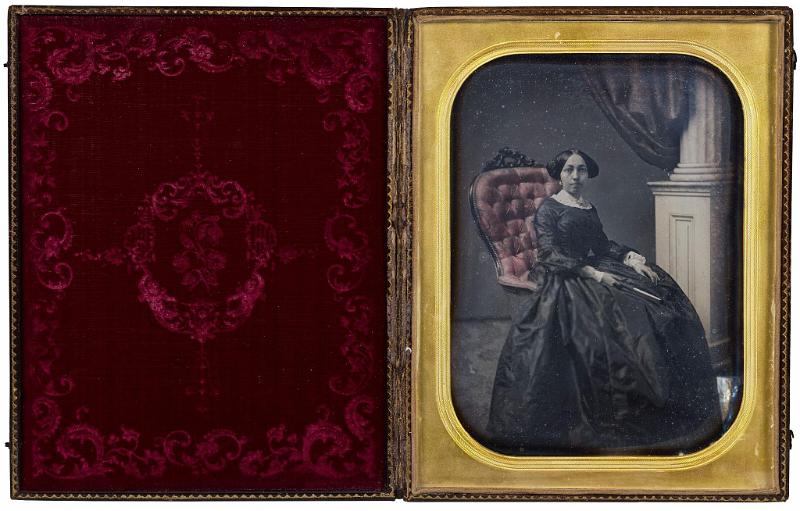
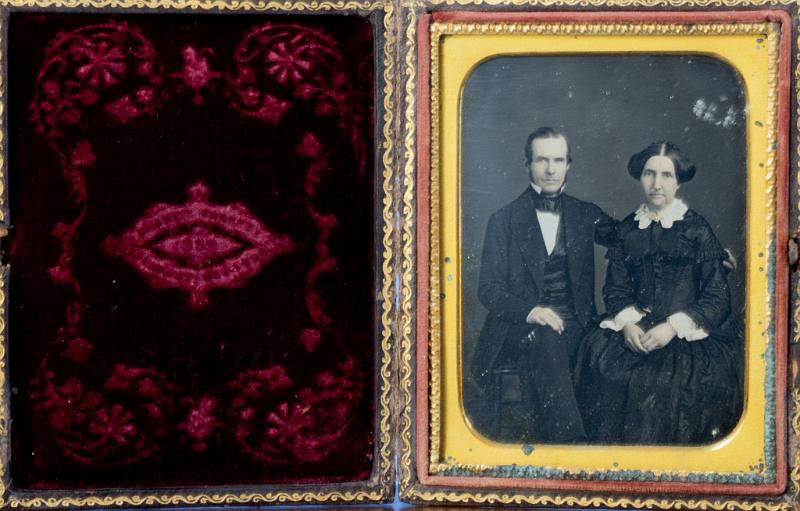
InformationFull plate Ambrotype featuring a group of 10 well dressed people of various ages standing and seated with a dramatic view of Niagara Falls behind them. The image is very crisp and is a fine example of a Babbitt ambrotype. The ambrotype has a period white oval mat with with a gold inside border. The image is in a fine full plate thermoplastic case. The inside lid is lined with burgundy colored velvet with a center pattern. The top of the case has a molded relief image depicting Washington Crossing the Delaware on both sides.
Condition: The ambrotype and the case are in excellent condition.
Dimensions of Case: Height 7 1/2 Inches, Width 9 1/2 Inches
Note: This whole-plate hand-colored ambrotype by Platt D. Babbitt shows tourists at Horseshoe Falls, Niagara Falls, New York, circa 1854-1870. Babbitt established himself as a professional photographer on the American side of Niagara Falls in 1853. He built a pavilion for his camera to take photographs of visiting groups, without the tourists' knowing. Babbitt finished his daguerreotypes, unique positive photographs made on silver-coated copper plates, and offered them for sale before groups left. He ran this lucrative business for almost two decades.
Note: He opened a gallery on Ridout Street in London, Ontario in November 1850.[1] He advertised as an itinerant in Niagara Falls. By 1853 he was established at Niagara Falls, NY,[1] in a pavilion overlooking the falls from where he sold daguerreotypes and ambrotypes to visitors. His photographs captured people standing near the edge overlooking the falls.[2] He also photographed wintery scenery in the area.
Babbitt photographed Joseph Avery on July 17, 1853 holding onto a log in the rapids above the falls. Avery was one of three men who lost their boat in the current. As the boat capsized, two of the men went over the falls and died, but Avery was able to hold onto a log pinned amongst rocks for 18 hours before succumbing after a series of failed rescue attempts.[3]
Babbitt continued in business until his death in 1879. His work includes glass stereo view images. Newspaper accounts report that he also made diapositive "window hanger" images. At least one of his stereo negatives is credited on an Anthony paper stereo view. He corresponded with Southworth & Hawes and purchased one or two of their parlor stereoscopes.[1] Photographer George Barker worked for Babbitt in Niagara Falls, New York.[4]
circa 1860
Classification(s)