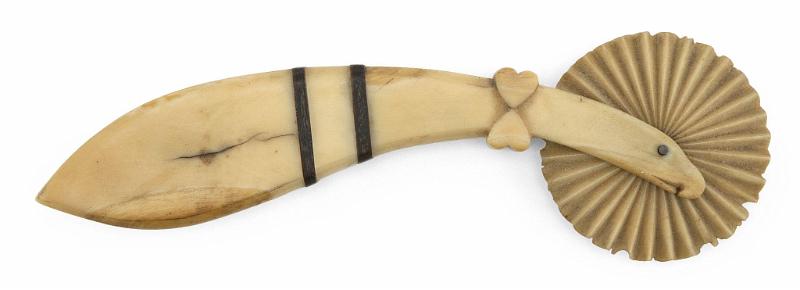
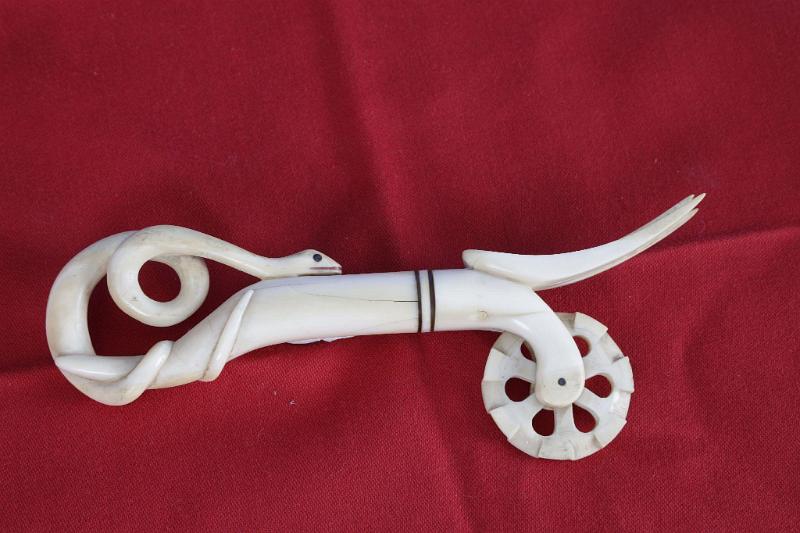
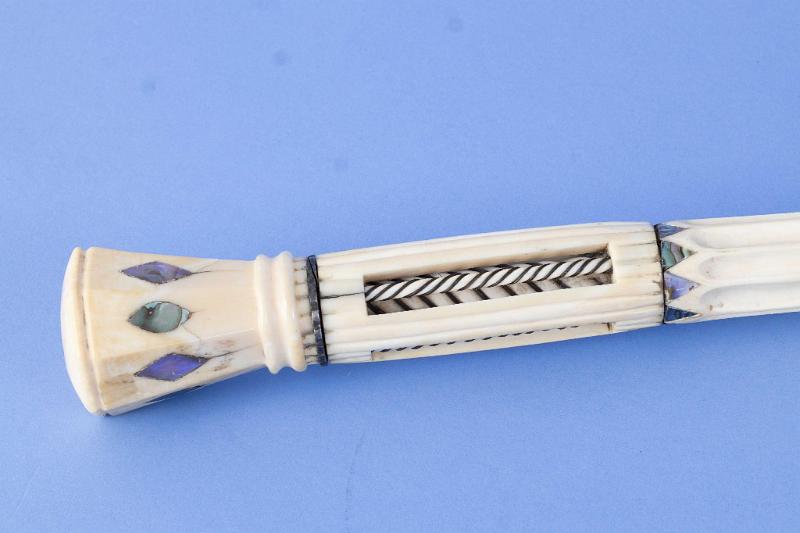
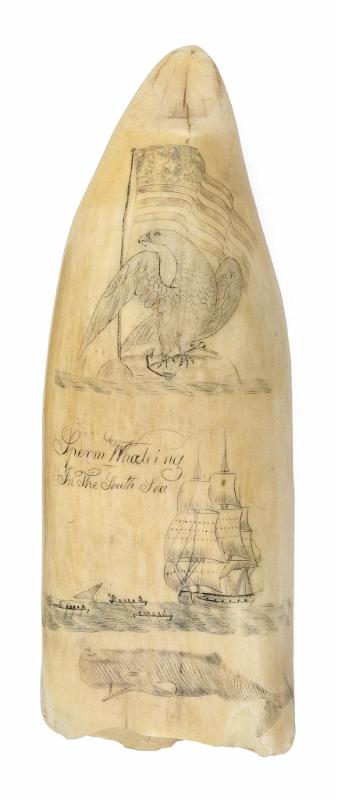
Exceptional One Piece Walrus ivory Unicorn Crimper, American, circa 1840
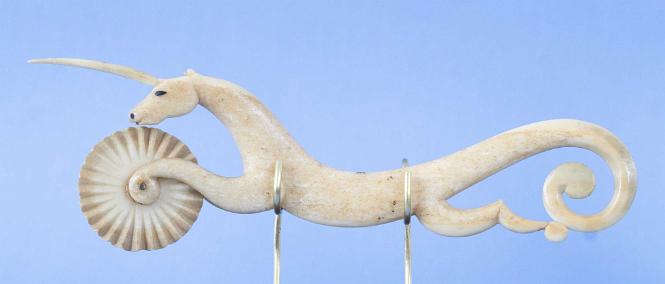
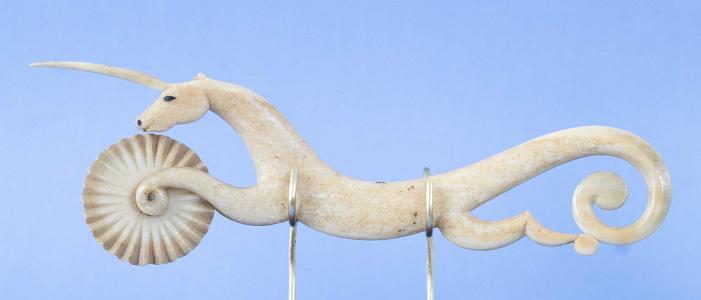
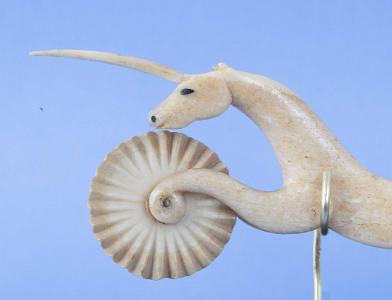
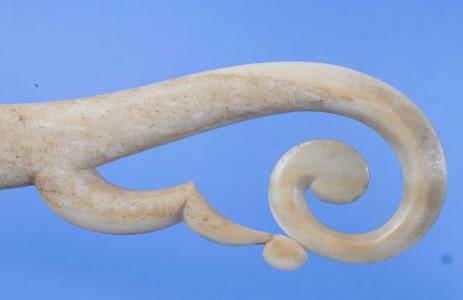
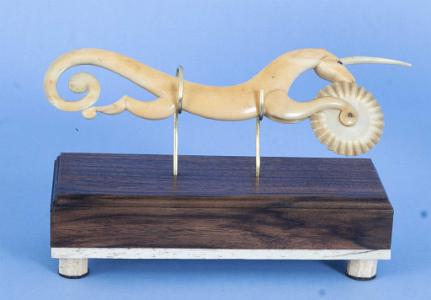
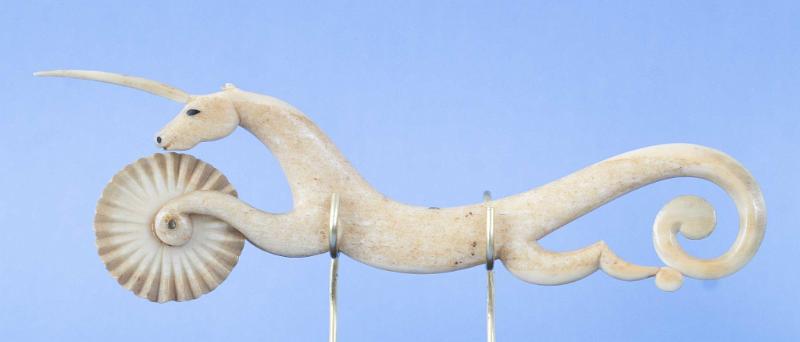
InformationWalrus ivory one piece scrimshaw pie crimper in the form of a running unicorn, American, circa 1840. The front of the unicorn has an out-stretched neck and arms. The mouth, ears and horn are beautifully articulated. The eyes and nostrils are inlaid ebony. The legs have a beautiful form and are extremely delicate and support the original whale ivory wheel. The rear section is in the form of an outstretched tail which has a graceful curl. The quality of carving and polish of this pie crimper are outstanding. It is a famous form and others by the same hand are well known to the scrimshaw literature. (SC1354)
Note: Since this unicorn crimper is made of walrus ivory which is obviously much larger than a whale’s tooth it is made from a single piece of ivory. The other examples by the same hand which are made from whale ivory have an ebony spacer at the waist.
Condition: The pie crimper has a beautiful age patina. There is a repair to the horn at the base of the head that is almost not visible.
Reference 1: Flayderman, E. Norman, "Scrimshaw and Scrimshanders Whales and Whalemen", Milford, Connecticut: N. Flayderman & Co,, Inc. 1973, pp.188 & 189. Other unicorn or sea horse pie crimpers are illustrated on these pages. An almost identical crimper by the same hand is illustrated on page 188.
Reference 2: McManus, Michael, "A Treasury of American Scrimshaw", Penguin Studio, 1997, p.60. An almost identical jagging wheel by the same hand is illustrated on page 60. This example is at the Peabody Essex Museum in Salem, Massachusetts, however the crimper at the museum is lacking the horns, tail and ebony spacer.
Reference 3: "Barbara Johnson Whaling Collection: Part IV", Sotheby's Catalogue, December 16 & 17, 1983, Lot 643. This pie crimper is illustrated in the catalogue as a full color page (as Plate XVI) and a full black and white page as described in Lot 643. The pie crimper in the Johnson Collection was carved by the same hand and has a few differences from the two referred to above.
Dimension: Length 8 inches.
Provenance: Collection of Paul DeCoste, Newburyport, MA.
Circa 1840